Chinese-branded cars topped Japanese brands in Europe for a quarter, on Dataforce figures Bloomberg reported
A Bloomberg story reprinted by the Taipei Times says Chinese-branded cars were 12.7 percent of European sales in the three months through September, ahead of Japanese brands at 11.9 percent, with a September record of 14.5 percent. The Japan Times and Straits Times pages attach 12.7 percent to September. None of them defines Dataforce's Chinese-brand group.
Last updated
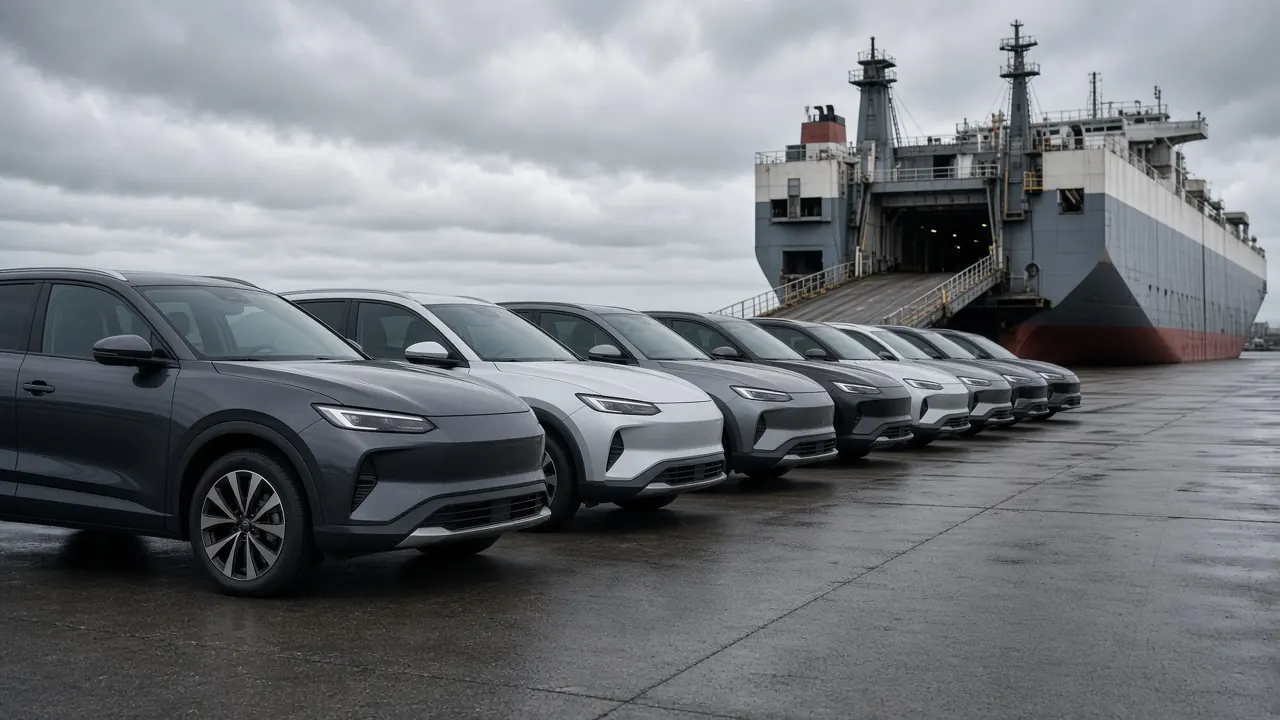
Chinese-branded cars outsold Japanese brands in Europe for the first time over a full quarter, according to market researcher Dataforce as reported by Bloomberg. The Bloomberg article did not load when this desk opened it on 27 October. An access block came back instead of the story. The figures below are from pages that credit Bloomberg and that did load, and they do not all print the same sentence.
The clearest split between the quarter and the month is in the Taipei Times of 27 October, on a business page credited to Bloomberg. It says registrations of Chinese-branded cars roughly doubled from a year earlier in the three months through September and made up 12.7 percent of total sales across the region, led by hybrids. It says that put them ahead of Japanese manufacturers, including Toyota, at 11.9 percent. It says the advance accelerated at the end of the quarter: Chinese brands' European share jumped to a record 14.5 percent last month, almost three percentage points higher than in August. "Last month" in a 27 October paper is September.
What the Japan Times and the Straits Times displayed
The Japan Times, dated 26 October and marked as Bloomberg, shows a shorter text before the subscription prompt. The opening says Chinese automakers outsold Japanese rivals in Europe for the first time over a full quarter, naming BYD and Chery. The next sentence says registrations of Chinese-branded cars roughly doubled from a year earlier in September to make up 12.7 percent of total sales across the region, led by hybrids, according to Dataforce, and that this put them ahead of Japanese manufacturers including Toyota at 11.9 percent. The visible text then says European manufacturers such as Volkswagen and Renault still dominate, that five years ago Chinese brands accounted for barely 1 percent of European sales, and that Japanese automakers have spent decades building a position in Europe. The 14.5 percent figure is not in the text that loaded. The page's own description meta tag repeats the September 12.7 percent sentence.
The Straits Times, published 26 October and ending with the credit "BLOOMBERG," uses the same September wording for the 12.7 percent: registrations of Chinese-branded cars roughly doubled from a year earlier in September to make up 12.7 percent of total sales across the region, led by hybrids, ahead of Japanese manufacturers including Toyota at 11.9 percent. Its opening line says Chinese automakers outsold Japanese rivals for the first time over a full quarter. The 14.5 percent September record is not in the Straits Times text this desk read.

The Taipei Times reprint is the page that separates a quarterly 12.7 percent from a September 14.5 percent. The Japan Times and Straits Times pages, in the text that loaded, attach 12.7 percent to September and still say the overtake was for a full quarter. This desk is not averaging those sentences or substituting one for the other. Readers who need the Dataforce table itself will not find it in any of these four links. Bloomberg's page did not open, and the others are news reports of Dataforce, not Dataforce's release.
What the reprint and the Straits Times add around the shares
The Taipei Times text says that five years ago Chinese brands accounted for barely 1 percent of European sales, and that Japanese automakers have spent decades in Europe. It says Toyota has sold cars in the region since 1963 and now operates factories across the continent, and that Nissan has produced vehicles at its Sunderland plant in the UK since 1986. It says China's cars are especially successful in Britain, where Chery's Jaecoo 7 was the country's best-selling model in March and last month. The Straits Times prints the same Toyota, Nissan, and Jaecoo 7 lines, with September named as the second month for the Jaecoo 7.
Both the Taipei Times and the Straits Times say Chery, BYD, and Geely's Zeekr showed new models at the Paris show earlier in October, including the BYD Dolphin G DM-i, which they call a compact plug-in hybrid developed for Europe. Both say that after extra tariffs on China-made battery-electric vehicles, the European Union this month agreed in principle to curb imports of hybrid cars from China. The Straits Times says the EU is also considering rules that would favour locally made cars when granting subsidies. Those lines are the papers' account. This desk did not open an EU legal text for this story.
On factories, the Taipei Times says Chery is preparing production in Barcelona, BYD is nearing completion of a manufacturing site in Hungary, and Zhejiang Leapmotor has started making its B10 SUV at a Stellantis plant in Zaragoza, Spain, as part of a joint venture. The Straits Times prints the same three production lines. A separate Industry story is about BYD's plant in Brazil, not Hungary. September battery-electric shares from other publishers, including AAA Data for France and the KBA for Germany, are in a Policy desk story. Those shares are not the Dataforce series in this piece.
What these pages do not define
None of the Japan Times text, the Straits Times text, or the Taipei Times reprint says what Dataforce counts as a Chinese brand, or whether a brand with European production or a European parent is inside that group. None of them says that "the region" means the European Union, the EFTA countries, and the UK. The phrase in the loaded text is "across the region" or "European." Because those pages do not define the bucket, this story does not either.
The lead comparison is Dataforce's, via Bloomberg, as the Taipei Times reprint prints it: 12.7 percent for Chinese-branded cars in the three months through September, 11.9 percent for Japanese manufacturers, and a September share of 14.5 percent. The Japan Times and the Straits Times are cited for the wording they actually displayed, which ties 12.7 percent to September.