Tesla's third-quarter revenue stayed near $28 billion as deliveries eased and storage orders rose
Tesla's 10-Q reports $28.05 billion of third-quarter revenue, a $49 million dip from a year earlier. Deliveries fell, energy-storage revenue fell, and the company says battery supply still limits how fast auto output can grow.
Last updated
This is not financial, tax, or investment advice. It is a report. Confirm the figures with the cited source and a qualified adviser.
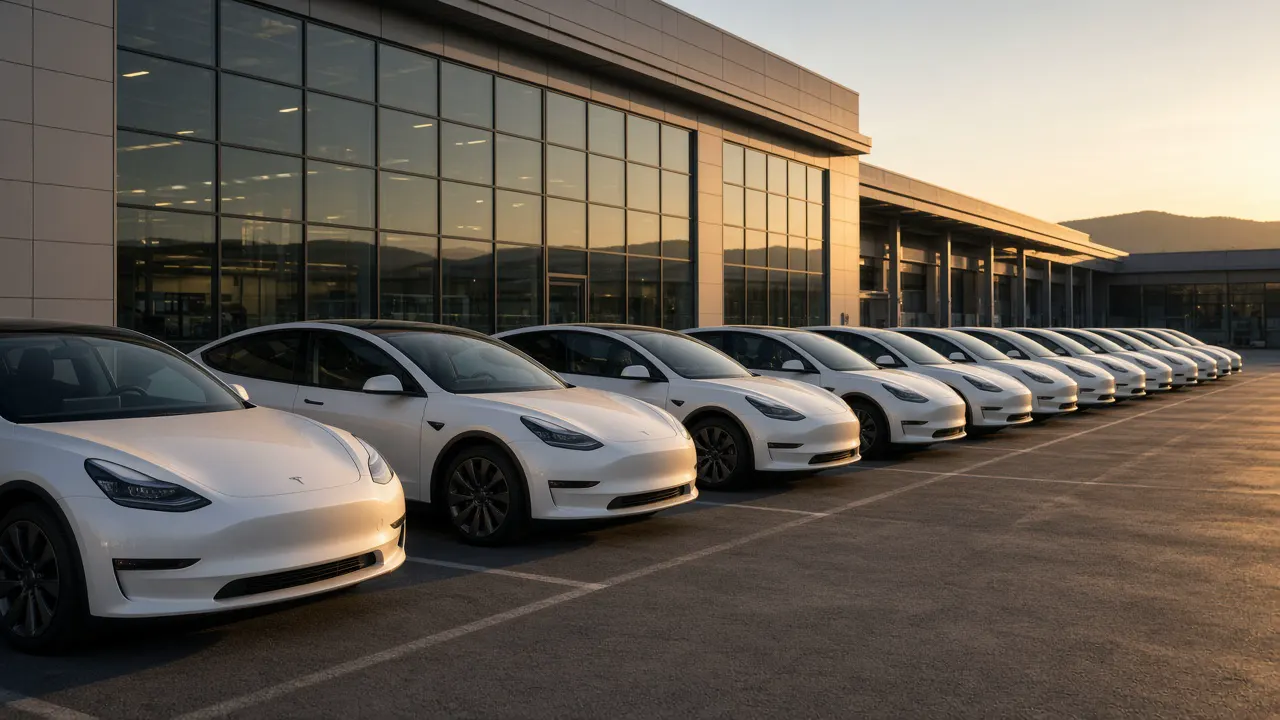
Tesla's third-quarter revenue was $28.05 billion for the three months ended 30 September 2026, according to the overview in its Form 10-Q. That is $49 million less than the same quarter a year earlier. The filing's revenue table prints the same quarter as $28,046 million. The Q3 2026 Update describes total revenue as roughly flat year over year at $28.0 billion, and its financial summary marks the change as 0 percent, from $28,095 million to $28,046 million.
The pieces of that total moved in different directions. In the 10-Q, automotive revenue was $20,560 million, down $645 million, or 3 percent. Energy generation and storage revenue was $2,881 million, down $534 million, or 16 percent. Services and other revenue was $4,605 million, up $1,130 million, or 33 percent. CNBC's 21 October report described the same quarter as $28.05 billion of revenue, automotive revenue down 3 percent to $20.56 billion, and energy revenue down 16 percent to $2.88 billion.
Deliveries fell while production rose
The update's operational table lists 486,532 deliveries, down 2 percent from 497,099, and 464,391 vehicles produced, up 4 percent from 447,450. Model 3 and Model Y deliveries were 478,237. Other models were 8,295, down 48 percent. The update says these are passenger vehicles sold to customers, and that a delivery counts only once the car is transferred with the paperwork done.
The 10-Q explains the automotive sales line inside those totals. Automotive sales revenue decreased $265 million, or 1 percent. Tesla attributes that to a decrease of about 2 percent in cash deliveries, "primarily from fewer Model S and Model X deliveries after the product sunset in mid-2026," partly offset by a weaker U.S. dollar against other currencies and by higher revenue from FSD (Supervised) subscriptions. The update's own list of revenue items names a lower vehicle average selling price, lower regulatory-credit revenue, and fewer deliveries, against growth in services, a $0.3 billion currency benefit, and higher ancillary automotive sales driven mainly by those subscriptions.
Margins rose on the gross line and fell on the operating line
Gross profit and operating profit did not tell the same story. The 10-Q reports total gross profit of $5,494 million and a total gross margin of 19.6 percent, compared with 18.0 percent a year earlier. Automotive gross margin increased from 17.0 percent to 18.5 percent. The 10-Q says that increase was primarily the swing in automotive sales revenue and cost, partly offset by lower regulatory-credit revenue. Energy generation and storage gross profit was $954 million, down from $1,073 million, while the segment's gross margin increased from 31.4 percent to 33.1 percent.
Income from operations was $718 million, compared with $1,624 million a year earlier. The update prints a 2.6 percent operating margin, against 5.8 percent a year earlier, and GAAP net income attributable to common stockholders of $787 million, which its table marks down 43 percent from $1,373 million. The 10-Q calls that net-income change a decrease of $586 million. The update says the results webcast began at 4:30 p.m. Central Time on 21 October 2026.
The update says operating income was lower because of higher research, stock-based compensation including the 2025 CEO Performance Award, and administrative costs, plus lower regulatory-credit revenue and lower energy gross profit. The 10-Q puts research and development at $2,761 million, up 69 percent, and says the increase was mainly programs it groups under "SI" and other work, including Optimus, silicon, battery technologies, and new vehicles. Automotive regulatory credits in the update were $113 million, against $417 million a year earlier. The 10-Q says that line fell $304 million, or 73 percent, and that recent government actions have restricted certain credit programs tied to Tesla products.
Battery supply is the limit Tesla names on vehicle volume
In the highlights, Tesla says that while it made more progress securing future supply, battery availability "continued to be the limiting factor in increasing auto volumes in the quarter." In the infrastructure section it says battery availability "remains a limiting factor on the pace of our global vehicle production ramp," and it points to vehicle-pack capacity in Berlin, cathode material and lithium refining in Texas, and lithium-iron-phosphate cells in Nevada for storage products.
The 10-Q does not use that "limiting factor" sentence. It does say Tesla will have to keep adequate cell supply as storage lines grow, and that U.S. import tariffs and the statute the filing calls the One Big Beautiful Bill Act could raise cell expenses.
Storage deployments rose while storage revenue fell
The update says storage deployment was 13.7 gigawatt-hours, against 12.5 a year earlier, a change the table marks as 10 percent. Tesla says demand "remained strong," with its "highest-ever order rate and backlog," and that it expects data-center demand to keep driving orders. It defines deployment as installed customer units plus equipment sales at delivery.
The 10-Q gives the revenue side of that quarter. The 16 percent decline, it says, was primarily tariff refunds for certain Megapack customers, a lower average selling price per Megapack, a decrease in Powerwall deployments, and a decrease in solar-retrofit cash deployments, partly offset by an increase in Megapack deployments. Cost of energy revenue fell $415 million, or 18 percent, to $1,927 million. The filing says that cost decline, and the margin increase from 31.4 percent to 33.1 percent, followed those deployment swings, tariff refunds, and a lower average cost per Megapack.
Both documents describe a new factory and a first cell shipment. The update says Megafactory Texas began production, with planned Megapack capacity of 50 gigawatt-hours, and that Tesla shipped the first Megapacks built with LFP cells from its Nevada factory, "comprised solely of our own LFP cells." The 10-Q says a new Megafactory near Houston, Texas, began production in the third quarter, and that Tesla shipped the first Megapack with LFP cells manufactured at Gigafactory Nevada. The 10-Q says the 33 percent rise in services and other revenue came primarily from used-vehicle sales, maintenance and collision work outside warranty, and paid Supercharging.